


West and East Building Rosters at Different Speeds with Divergent Strategies
Four days into the Alliance High School Dynasty League startup draft, two conferences are building franchises with wildly different philosophies—and neither is wrong.
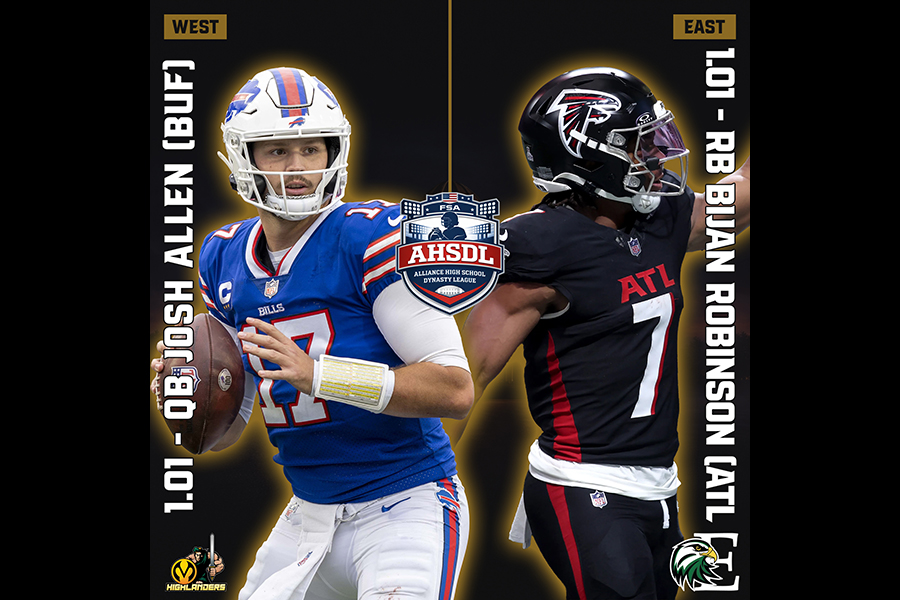
The Western Conference sits at pick 7.07, having opened with quarterback mania that saw eight signal-callers taken in the first twelve selections. MacArthur Highlanders set the tone by selecting Josh Allen first overall at 8:24 AM on April 13th. By the time Mount Pleasant grabbed Jalen Hurts with the final pick of Round 1, two-thirds of the first round had gone to quarterbacks. Only two running backs—Bijan Robinson and Jahmyr Gibbs—and two wide receivers—Puka Nacua and Jaxon Smith-Njigba—survived the quarterback frenzy.
The Eastern Conference took the opposite approach. Ernestown Eagles selected Bijan Robinson first overall in four seconds flat from their pre-draft list, establishing a run-first mentality that defined their opening round. Four of the first five picks were running backs: Robinson, TreVeyon Henderson, Gibbs, and Christian McCaffrey. By comparison, only four quarterbacks were taken in Round 1—Josh Allen sixth, Drake Maye seventh, Lamar Jackson eleventh, and Jalen Hurts twelfth.
The strategic divergence reveals how Superflex scoring and TE Premium create competing scarcities. Western Conference general managers prioritized quarterback depth, understanding that without two elite signal-callers in Superflex formats, championship windows close quickly. Eastern Conference GMs valued running back scarcity in dynasty formats, recognizing that premier backs have shorter careers and replacement value diminishes rapidly.
The D'arcy McGee Gee Gees executed the draft's most aggressive move, trading up to acquire the twelfth overall selection from Shadyside Casket Makers. That Third Round Reversal position—holding picks twelve, thirteen, and twenty-five in the opening three rounds—gave D'arcy McGee both Gibbs at third overall and Hurts at twelve. The Gee Gees now own elite running back and quarterback talent acquired through contrasting draft capital.
Rookie Draft Spots have begun appearing on draft boards. The Eastern Conference saw Massillon Tigers claim the first spot at pick nineteen (2.07), while Western Conference GMs waited until pick thirty-two (3.08) before Moreno Valley Vikings grabbed one. These spots represent fixed positions in the post-NFL Draft Rookie Draft, allowing GMs to balance veteran talent with future draft capital.
The Eastern Conference currently sits at pick 6.06, trailing the Western Conference's 7.07 position by approximately one round. Both conferences have extended their midnight-to-6:00 AM pause windows on multiple occasions, accommodating general managers navigating life commitments alongside franchise construction. Some picks have taken hours as GMs weigh veteran production against future value, roster construction against positional scarcity.
Twenty-six rounds of decisions stretch ahead. Two conferences building differently but deliberately. One marathon, two philosophies, twenty-four franchises taking shape one selection at a time.