


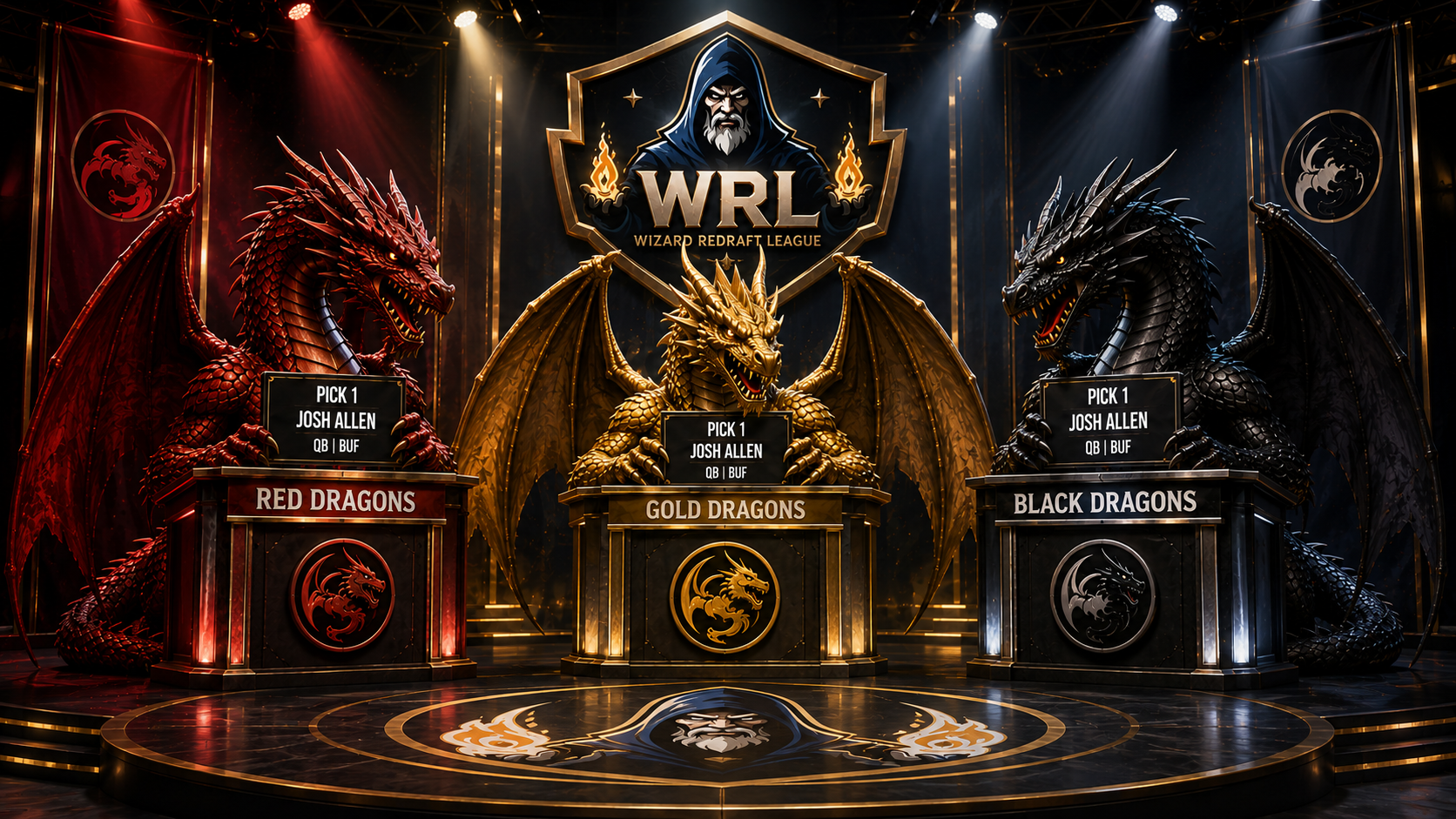
For all of the chaos that went into determining where teams would draft, the actual drafting portion of the 2026 Wizard Redraft League turned out to be remarkably orderly. Over three separate nights, 36 General Managers entered three independent draft rooms, stared at the same NFL player pool, and built 36 different rosters for the inaugural Tri-Regional Championship.
All 36 GMs showed up live. All three drafts finished in under three hours. There were no major technical failures, no disappearing owners, no commissioner rescues and no draft-night disasters worthy of their own chapter in FSA folklore. The Red Dragon Region finished its 16 rounds in 2 hours, 25 minutes. Gold needed 2:37 despite a few harmless clock pauses. Black, perhaps appropriately for the region that prefers to operate from the shadows, quietly finished fastest at 2:16.
The drafts themselves, however, were anything but identical.
One Thing Everyone Agreed On
If the three Dragon Regions could agree on only one thing, apparently it was Josh Allen.
Garbage Points made the Buffalo quarterback the first overall selection in the Red Dragon Draft. Eight days later, the Gridiron Grinders did exactly the same thing when Gold took its turn. Then Maniax completed the sweep Saturday afternoon by selecting Allen first overall in Black.
Thirty-six different GMs. Three separate drafts. Three separate opportunities for somebody to zag.
Nobody did.
The agreement extended surprisingly deep into the top of the board. Ja'Marr Chase was fourth overall in all three drafts. Gold and Black opened identically with Allen, Jahmyr Gibbs, Bijan Robinson and Chase, while Red used the same four players and simply flipped Robinson and Gibbs at picks two and three.
Through four selections, there was almost a WRL consensus.
Then the Dragons started acting like themselves.
Red Dragons Came for the Quarterbacks
Red was easily the most aggressive quarterback region from the opening bell.
Six of the first 12 selections were quarterbacks, compared with only three apiece in Gold and Black. Allen started it at 1.01, but the real rush began halfway through the round. Lamar Jackson went sixth, Jayden Daniels eighth, Drake Maye ninth, Patrick Mahomes tenth and Joe Burrow eleventh. Christian McCaffrey at seventh overall was the only non-quarterback selected between picks six and eleven.
Red essentially looked at the Super-Flex format and decided there was no reason to be subtle about it.
By the end of Round 2, eight quarterbacks were already gone. That number becomes more interesting when compared with Gold, because Gold also had eight quarterbacks selected through two rounds despite taking only three of them in the first. The two regions ultimately arrived in the same neighborhood, but Red sprinted there while Gold took the scenic route.
That may ultimately mean absolutely nothing once games begin. Fantasy drafts have a wonderful habit of humiliating anyone who declares a winner in August. But it does tell us something about how Red approached roster construction: quarterback scarcity was treated like an immediate problem that needed solving.
Gold Got Weird — In the Best Possible Way
Then came Gold.
The Gold Dragon first round looked much more skill-position heavy: three quarterbacks, four running backs and five receivers. Five of the first ten selections were wide receivers, and Josh Allen remained the only quarterback taken until Drake Maye went seventh.
Then came Matthew Stafford at No. 11.
Stafford was not merely a first-round quarterback. He was QB3 in the Gold Dragon Region, coming off the board before Lamar Jackson, Patrick Mahomes, Joe Burrow and several others. Trevor Lawrence later became QB6 in Round 2, also going before Burrow and Mahomes.
That was merely the beginning of what made Gold fascinating.
Crayon Crusaders selected Brandon Aubrey in Round 7, making him the first kicker drafted in the region before a single defense had been selected. The Crusaders later doubled down by drafting a second kicker, Tyler Loop, in Round 9. Meanwhile, NY Jackets completed an entire 16-round draft with only one quarterback on the roster, Bo Nix, selected in Round 3.
There is unconventional roster construction, and then there is whatever was happening in parts of the Gold Dragon draft room.
None of that means those decisions were wrong. That is precisely what makes them worth remembering. If one of those strategies works, we already know where the story started. If it crashes spectacularly, well, we know where that story started too.
Gold was interesting because it refused to give us a clean template.
Black Waited... Until It Didn't
Black matched Gold's first-round positional breakdown exactly: three quarterbacks, four running backs and five wide receivers.
The similarity ended there.
Through the first ten picks of the Black Dragon Draft, Josh Allen was the only quarterback selected. Eleven straight selections did not pass without another quarterback only because Lamar Jackson finally went at 1.11, immediately followed by Drake Maye at 1.12.
By the end of two rounds, Black had selected only six quarterbacks. Red and Gold had each taken eight.
For a while, it looked as though the most decorated region in the WRL had collectively decided there was no quarterback shortage at all.
Then Round 4 happened.
Matthew Stafford, Trevor Lawrence, Patrick Mahomes, Jared Goff, Kyler Murray and Justin Herbert disappeared during a seven-pick stretch, with Tee Higgins serving as the lone interruption. After three-plus rounds of relative patience, Black suddenly produced one of the most concentrated quarterback runs of any draft.
That sequence might be my favorite regional contrast of the three drafts. Red treated quarterback like an emergency from the beginning. Gold approached the position in its own wonderfully peculiar order. Black waited long enough to make everyone comfortable — and then six teams apparently reached the same conclusion almost simultaneously.
Same scoring system. Same player pool. Very different rooms.
The First Victory Belonged to the League
There is another number worth remembering before any of these rosters score a point:
36-for-36.
Every General Manager drafted live.
For a league this large, spread across three regions and three separate draft dates, that matters. Red completed its draft without a missed pick or meaningful delay. Gold needed several minor clock pauses but still finished only 12 minutes slower than Red. Black rolled through its board in 2 hours, 16 minutes.
The Draft Order Gauntlets were designed to create chaos. The drafts themselves delivered the opposite: three efficient nights in which every owner was present and every roster was built by the person who will actually manage it.
That may not generate the loudest headline in August, but it says something encouraging about the league heading into September.
Now We Find Out Who Was Right
There will be plenty of time to grade these drafts incorrectly.
Somebody we barely noticed will become a league winner. A selection that looked strange in August will look brilliant in December. Somebody currently thrilled with their roster will be cursing the entire sport by Week 4. This is fantasy football. Humility is eventually mandatory.
What we know today is simpler.
All three Dragon Regions agreed that Josh Allen belonged at the top. They largely agreed on the elite group immediately behind him. Then, as the boards stretched deeper, three distinct approaches began to emerge. Red aggressively protected itself at quarterback. Gold produced the most unconventional collection of decisions. Black showed patience before triggering a quarterback avalanche of its own.
The 2026 WRL asked 36 General Managers to enter three separate rooms and solve the exact same problem.
They came back with three different answers.
And now that the drafting is finally over, the fun part begins.
The Dragons get to prove it on the field.