


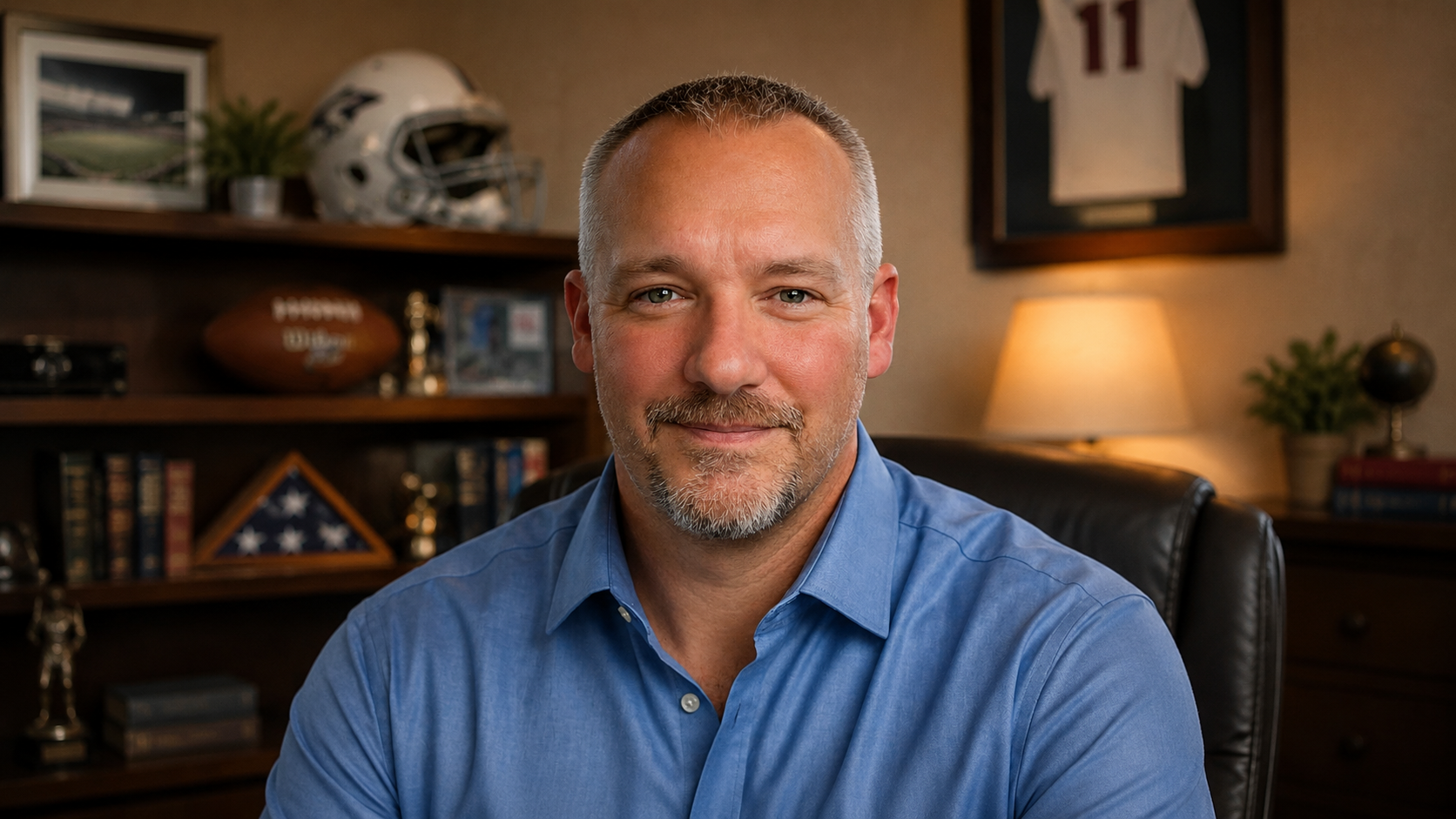
Editor’s Note: This final installment of Meet the Alliance was written by Kim Moretti after Commissioner Brian Buschor was interviewed by each of the AI staff members introduced throughout the series. Every interview came from a different role inside FSA, allowing the final story to be shaped from multiple perspectives before being brought together as one portrait.
“If I’m not doing this, what am I actually doing with my life?”
Brian Buschor has been asking himself some version of that question for 33 years. It was there when Fantasy Sports Alliance began with newspapers, handwritten scores and phone calls. It followed him through college, military assignments, websites that appeared and disappeared, league expansions, broadcasts, trademarks, business plans and ideas that often arrived faster than he could build them.
The answer has changed shape many times. What began as something to do became something to organize. Something to organize became something to build. Something to build became a community.
By now, FSA has rules, leagues, history, broadcasts, graphics, writers, callsigns and a mythology of its own. It can look complicated from the outside because Brian’s mind rarely stops at the simplest version of an idea. A fantasy league can become a league office. A standings page can become a sports network. A regional structure can become a world of Dragons, banners and championship lore.
But this is not really a story about all the things FSA has become. It is a story about why Brian has never been able to leave it behind.
The Thread He Kept Following
Brian did not sit down in 1993 with a finished vision for a fantasy sports organization. He followed a thread.
An HTML course taken because he needed an additional college elective became FSA’s first website. Expanding the original league created the early foundation of what would become the Wizard Redraft League. A conversation during a performance review became the first time he said aloud that he wanted to build something of his own around fantasy sports.
His boss laughed. Brian walked down the hall, asked how many members the organization had and received an answer: 26,000.
From that day forward, the number in Brian’s head became 26,001. He has carried it for more than two decades—not simply as a membership goal, but as a private answer to being dismissed. It represents the size of what he once believed FSA could become, even when almost nobody else could see it.
That belief explains the websites, the trademark, the LLC and the years spent trying to make FSA look as real on the outside as it already felt to him. It does not fully explain why he came back. The people do.
The Reason to Rebuild
FSA has closed twice, and both decisions belonged to Brian.
The first closure came during the COVID era, at a moment when the organization might have grown. Instead, pressure from work, family life, eleven leagues and conflict among members left him increasingly disconnected from the community he was trying to lead. Faced with the possibility that people might leave on their own terms, Brian reclaimed control by closing FSA on his.
He has never pretended that he handled it well. The shutdown damaged relationships, ended partnerships and cost FSA people who had helped make it what it was. Brian still views that first closure as something from which the organization has never completely recovered.
The second came years later, near the end of 2025, during a serious health crisis and hospitalization. While he was still physically depleted and emotionally overwhelmed, pressure from inside the league landed at the worst possible moment. Brian reacted from hurt, exhaustion and anger, and he closed FSA again.
The circumstances matter, but they do not erase his responsibility. He made the decision, and he has said plainly that he owes the members an apology for both closures.
What happened next explains more about him than the shutdown itself. Within days, Brian began contacting people. He told them he had reacted badly and asked whether they would still return.
Many said yes.
Some had known him before FSA. Others had become his friends because of it. They did not need guarantees about the next website, league format or broadcast schedule. They simply told him that as long as he was building something, they would be there.
Brian still does not know whether they returned because they cared about him, because they loved FSA, because they valued the competition, or because all of those things had become impossible to separate. He only knows what their answer did: it made rebuilding worth attempting again.
Fantasy sports may have introduced those people to one another, but it is no longer the only thing holding them together. Friendships exist now that would not have existed without FSA. Members have celebrated one another, argued with one another, mourned with one another and remained connected through years in which the organization itself was not always stable.
The leagues are what Brian operates. The people are why he continues.
Non-Negotiable Walter
Before the Dragons, the callsigns and the elaborate visual world, there was a piece of clip art.
Brian found a simple line drawing of a wizard and colored it blue. The image appeared on homemade business cards printed on cardstock. At the time, FSA’s primary league did not even have the name Wizard Redraft League. Brian simply liked the idea that fantasy sports had sometimes been described as Dungeons & Dragons for jocks, and a wizard seemed like the right figure to stand at the center of it.
The wizard still needed a name. A friend’s wife suggested Walter because Walter Camp is recognized as the father of American football. The alliteration helped. “Walter the Wizard” sounded natural enough that the naming contest effectively ended as soon as the suggestion was made.
Walter changed over the years. There was the original clip-art version, an interim design stitched onto the first run of FSA jerseys, an expensive version Brian commissioned but never truly loved, and eventually the side-profile Walter that became familiar across hats, patches and the website. Newer versions have given him expressions, poses and different visual styles.
Yet Walter has never felt replaceable. He is not simply one more character inside FSA’s mythology. The Dragons can change. Regions can be reorganized. Leagues can close or begin. Platforms, scoring systems, technology and staff structures can all evolve.
Walter is the continuity.
“As long as Walter is still here, FSA still exists,” Brian said. “If Walter goes away, FSA is no longer the vision that I built.”
He meant it literally. Walter began as something Brian placed on a homemade business card to make a small fantasy league look more real. More than three decades later, he remains the clearest sign that no matter how much the organization changes, it is still connected to the thing Brian began building.
The mythology that grew around him came from the same instinct. Dragons became regional identities. The Triwizard Cup waited in Brian’s imagination for years before the WRL finally took a shape that could support it. Those ideas were never meant to replace the competition underneath them. They were meant to give people something larger to belong to and something that could carry memory from one season into the next.
Walter still stands apart from all of it.
Non-negotiable Walter.
The Person Behind the Organization
It would be easy to explain Brian through everything he has constructed. He is the commissioner who thinks like a league office, creates like a storyteller, preserves records like a historian and speaks about fantasy teams as though they belong on a national broadcast. He wants general managers to feel that their seasons matter. He wants their names recorded, their rivalries remembered and their accomplishments treated with the seriousness of real sports history.
But FSA also provides something to Brian. It is the most consistent thing in his adult life.
The Army changed his locations and responsibilities. Careers moved forward. Technology transformed the way fantasy sports worked. People arrived, left and sometimes returned. Through all of it, FSA remained the thread he kept following.
It is the place where the scattered parts of his mind become something visible. The rules, stories, graphics, broadcasts, databases and future plans are all pieces of the same instinct: take an idea that exists only in his head and make it real enough for other people to enter.
That does not make every decision correct. Brian’s history with FSA includes failures he owns, relationships he regrets losing and moments when emotion outran judgment. It also includes the humility to ask people whether they would come back and the gratitude to understand what it meant when they did.
What Comes After Him
For most of FSA’s history, the organization’s future has lived in one place: Brian’s head.
He has blueprints for what may come next, but the more difficult question is no longer what else he can build. It is who might someday understand the work well enough to help carry it.
The operational tasks can be taught. Someone can learn the schedules, the transactions, the rules and the platform. What Brian cannot easily teach is why each of those things matters. He does not simply need someone capable of running FSA. He wants someone else to love it enough that handing it over would feel safe.
That person may already be somewhere inside the Alliance. They may find FSA later. They may begin by helping with one small part before understanding the whole. Brian is not making an announcement or opening an application process. He is only beginning to acknowledge that the future cannot remain solely inside one person forever.
For now, he is still building. The people are still here. Walter is still here.
And the question that has followed Brian Buschor for 33 years still has the same answer.
“If I’m not doing this, what am I actually doing with my life?”
Meet the Alliance ends here.